emotional well-being

  • Taking good care of ourselves can be a radical act in this day and age. Tapping into our inner wisdom, choosing to stay present with ourselves, and responding with compassion is downright revolutionary.

    I’m not talking about tropical vacations, spa days, bath bombs, mani-pedis or goopy facial masks. (Unless that’s your thing.) There’s nothing wrong with pleasure-full indulgences, but that is not the heart of self-care.

    What I’m talking about is committing to a daily practice of caring for yourself in only the way you can.

    The simplest, safest, yummiest, and most impactful way I know how to do that (and I’ve been exploring for nearly 30 years!) is Reiki.

    Anyone can learn how to do Reiki. It’s simply the art of connecting with universal life-force energy (which surrounds us all the time) and using intention and attention to direct it for well-being or any other goal that is aligned with your highest good.

    It can be used to support magical and mystical studies, but in and of itself, it’s a very practical technique. There’s no need to have any woo-woo inclinations whatsoever (unless that’s your thing). The power is in the application. Meaning, when you make time to give yourself consistent Reiki treatments, over time you’ll see tremendous benefits.

    It doesn’t require any special skills or pre-disposition. No fancy setup, music, crystals, oils, or herbs are necessary (unless that’s your thing).

    All you need is a desire to experience something different and a willingness to take consistent action.

    You’ll notice that I’ve used the word “consistent” several times. That’s because the work of healing means restoring balance in a world that is constantly promoting imbalance and integrating body, mind, and spirit in a culture that values the mind at the expense of the rest. Changing patterns against the tide requires devotion.

    But it doesn’t need to be hard or even time-consuming. 10-20 minutes per day, most days of the week can contribute to amazing results. If you truly desire change, that’s a small price to pay!

    I’ve created the most compact training for ordinary folks who want to participate in cultivating their own wellness, happiness, and creativity. My Reiki for Self-Care and Empowerment Class is coming up soon. It’s three 90- minute online classes. It’s the most convenient, affordable, accessible class I teach and it begins March 23, 2023.

    Investment in yourself = $113.

    Come and join the revolution.

    Easy, Accessible, Doable Self-Care

    Taking good care of ourselves can be a radical act in this day and age. Tapping…

  • This is a mini-version of my Reiki 1 class, designed for busy folks who have no intention of starting a professional practice or sharing healing with others. It’s the bare bones, no frills package.

    Reiki is my go-to tool for maintaining my health and sanity into my elder years, minor first aid, pain and stress relief, healing old trauma and wounds, cultivating emotional balance, and connecting with my deepest self, inner wisdom and innate power.

    It’s helping to free me from limiting beliefs and unconscious identities by allowing me to access clarity, discernment, motivation, and passion. It’s helped me to uncover and integrate mental, emotional, and energetic blockages and move past harmful and unskillful coping mechanisms.

    Because I use it every day. If you’re interested in learning a technique that can totally rock your world, Reiki can do that. But understand that it won’t do much for you unless you apply it consistently. If you can commit to a 15-ish minute practice most days, then you’re in the right place. If you’re looking for a quick fix, this isn’t it.

    (P.S. There are no quick fixes! Just bypasses, distractions, and suppression. These are the opposite of holistic healing.)

    We’ll cover the basics about what Reiki is, where it comes from, and what it can be used for. After the attunement (the initiation where I open students’ energy fields so that Reiki can be received) and instruction on how to use it. And we’lldiscuss how to find a way to practice that suits your life.

    And that’s it! If you’re looking for an opportunity to connect with other folks or in-depth discussions about how amazing Reiki is, this probably isn’t the class for you. I’d suggest Reiki 1 certification instead. (The next round will be this summer.) We take more time for these aspects there.

    If you’re wanting to have access to healing life-force energy at your very fingertips with minimal fuss and expense, then you’re in the right place. If you’ve been wanting to do this for ages and haven’t yet found the time, you’re exactly the type of person for whom I’ve created this class.

    Saturday, July 15. 9am – 1pm

    $111. $11 early bird discount until 7/3.

    Reiki for Self-Care and Empowerment Class

    This is a mini-version of my Reiki 1 class, designed for busy folks who have no…

  • For the past few months, I’ve been making videos about how I approach common maladies with holistic and energetic techniques. Life gives me consistent material and I simply record what I’m doing for myself. There are a number of very simple tools that can be used for a wide variety of challenges.

    Awareness

    Compassion

    Slowing down

    Reducing unnecessary stimulation

    Breath

    Sound

    Movement

    And my all-time favorite, Reiki

    If you experience overwhelm, you can get relief in just a few minutes. Better yet, you can minimize overwhelm’s frequency, duration, and intensity by aligning your behavior with your values and vision and regulating the nervous system.

    The most effective and affordable approach I know it to learn how to give yourself Reiki treatments. If the do-it-yourself suggestion triggers even more overwhelm, consider booking a session. Relief is just a few clicks away.

    Feeling Overwhelmed? I am, and here’s how I’m working with it.

    For the past few months, I’ve been making videos about how I approach common maladies with…

  • If you’re looking for a way into a new gratitude practice or wanting to turn up the dial on your current efforts, tapping into the feeling sense is a helpful approach.

    It can also help to understand why our minds are so much more easily drawn to the negative and we have to actively pursue an alternative.

    I made a short video to offer support for anyone who’s floundering or whose oomph is fading. I think these super-simple tricks will make it easier to cement your practice because it feels so good.

    If you’re interested in going deeper into body-mind-spirit healing, let’s connect! I work with people in a variety of ways, including intuitive coaching, remote Reiki, and Reiki classes. If you’re in the neighborhood, there’s Reiki-massage and Reiki in Philadelphia.

    Embodied Gratitude

    If you’re looking for a way into a new gratitude practice or wanting to turn up…

  • I just loved this article by Emily Nagasaki, a sex expert who brilliantly straddles the worlds of science and emotions. It outlines a simple tip for communicating in close relationships to build emotional engagement.

    To Build Trust, Say the Nice Thing First

    An important idea that didn’t fit into my next book.

    I’ve been working on the trust section of my new book (the one about sex in long term relationships), and I wrote a big section on the relationship between individual differences in temperament and a person’s ability to be emotionally engaged—emotional engagement is the “E” in Sue Johnson’s language about trust. She says that trust is “A.R.E. you there for me?” where “A” is emotional accessibility, “R” is emotional responsiveness, and “E” is emotional engagement. Questions like “Am I there for my partner?” and “Are you there for me?” are excellent starting places for assessing the trust in your relationship.

    And the section just doesn’t fit in the book.

    So here! Y’all have it! I think it’s interesting and helpful—or at least it was for me, when I learned this stuff!

    Maybe you have a serious temperament. You’re someone who, ahem, notices what can be improved before you notice what’s already working. People might think of you as a pessimist, because your ability to notice things that can be improved can come across as if all you see is what doesn’t work.

    Let’s go way, way back to my early days of being in romantic relationships. I was in college. My certain special someone had just redecorated their dorm room. When I came into the refreshed space, they asked, “What do you think?”

    And I said…

    Well, what would you want someone to say to you, in these circumstances?

    You’d want them to say, “It’s great!” or “I love it!” or even “It feels so you!”

    The first thing I said was, “The rug is crooked.”

    Oh geez.

    And look, when my college dating partner asked me what I thought of their new room, it’s just not true that “The rug is crooked” is what I thought of the room. I thought it looked nice. I thought it gave me some ideas about what to do with my room. Above all, I thought they looked really happy with the change, and I was glad they were happy. And all of those thoughts mattered more than rug. But I noticed the rug first, so I mentioned the rug first, thus missing a moment of emotional engagement.

    My temperament is serious and analytical; I am excellent at identifying problems. I could give a lot of embarrassing examples here about times when I explained to people how they could solve their problem, and they surprised me by being angry with me for solving their problem. If that sounds familiar to you, your necessary skill is:

    Say the nice thing first.

    Saying the nice thing first is a crucial part of how to build and reinforce trust through emotional engagement. My partner needs and deserves praise, to know that I love and admire him, before I ask for a change, and that’s normal. It’s normal to want or even need to hear good things before we’re ready to accept critical things. Praise, admiration, and acceptance are how people build that tender, vulnerable emotional connection that characterizes so few of our relationships. That connection is emotional engagement.

    So even though I still notice what can be improved before I notice what’s working, I’ve learned to say what’s working before I say what can be improved. I’ve even learned that most of the time, people don’t want or need to hear what I think can be improved, they really only want and need to hear encouragement and support. And if they trust you, they’ll come to you when they encounter a problem.

    Criticism like “The rug is crooked” is just one of many flavors of non-engagement by a serious temperament. Other non-engaged first responses might sound like:

    Partner A: How about we try keeping the plates in a different cabinet?

    Partner B: Here’s the history of why the plates have always been where they are.

    Not malign, not even saying no, just… not emotionally engaged. Partner B is engaged with the history of their kitchen storage, rather than with Partner A’s interest in changing it. All Partner B has to do is engage with the idea of moving the plates beforethey reminisce about the origin story of the plate storage. Because it is actually true, isn’t it, that your partner’s feelings matter more to you than where you keep the plates.

    This can be as simple as:

    Partner A: How about we try keeping the plates in a different cabinet?

    Partner B: (with curiosity) You’d like to move the plates?

    Or:

    Partner B: (with affection) Remember when we found those plates at that second-hand shop? I love those plates.

    Or even—gasp!:

    Partner B: Sure. Which cabinet would be better?

    Sometimes “the nice thing” means you talk about the feelings people have before you talk about anything else. Does your partner want to tell you all about their success at work today? Start with, “Look how excited you are! I’m excited, too! Tell me all about it.” That’s emotional engagement.

    Does your partner want to tell you how they want to rearrange the furniture in the bedroom, because they keep bumping into things? Start with, “Definitely, I don’t want you getting hurt!” Emotional engagement. And then you help them move the furniture however they like and they will soon recognize what you already knew—that there was no better arrangement possible and actually you need to remove some stuff.

    These engaged responses are never insincere. Just because you have a critical, analytical awareness of things doesn’t mean you don’t also have a kind, affectionate awareness of those same things. You’re just choosing to say the kind, affectionate things first, so that your partner feels the warm glow of emotional engagement and your relationship is strengthened. Once the emotional engagement is reinforced, your partner is much more likely to be ready and willing to hear your important ideas about solutions, because they feel more trusting.

    Even when the stakes are far higher than moving furniture, I keep a rein on my critical analysis. If I’m worried about money, I start with honest praise and gratitude for the ways we have stayed on budget together. Only then do I say that I wonder aloud if the budget we decided on was too ambitious, or that I notice that our timeline for certain expenses has changed and I’m worried, but here’s a potential solution. (A secondary necessary skill for serious people: When you do present a problem, always accompany it with a potential solution.)

    Saying the nice thing first can be effortful, I’m not going to lie, and it is definitely not efficient. But efficiency isn’t the “e” that will keep trust strong in your relationship. Engagement is. Take the time to engage warmly with your partner before you try to problem solve, explain a situation, or contradict a person with whom you hope to sustain a satisfying long-term sexual connection. Emotional engagement prevents disagreements from escalating into fights, which ultimately both saves time and preserves and even reinforces trust.

    That way, you can use entirely efficient language when the building is on fire or someone broke a bone, when it’s an actual emergency. The well-established trust between you makes abrupt communication acceptable when it’s necessary.


    Say the nice thing first, because it’s honestly true that your partner matters more than any problem that pops into your head or any reluctance you feel about novelty or transitions. Build emotional engagement, to have trust that lasts.

    And use your knowledge of each other’s traits to increase your admiration for each other. Never use temperament as a weapon, never criticize or judge someone for their temperament, and never judge yourself harshly for having the temperament you were born with. And also, never use your temperament as an excuse for hurting someone or for letting trust break down in your relationship. Living with temperamental differences is just a matter of developing your communication skills, which all of us are capable of learning with practice. None of us are doing it wrong, all of us are doing it differently; none of us are perfect, we are all doing our best. When we turn toward our differences with kindness, compassion, and, yes, admiration, temperamental differences can enhance emotional engagement and trust.

    Emotional Engagement for Health Relationships

    I just loved this article by Emily Nagasaki, a sex expert who brilliantly straddles the worlds…

  • I’ve already chosen self-compassion as my theme for 2023. I’m guiding a group on New Year’s Day in my Meetup group, and figured I should do my own work ahead of time. I chose the solstice for my introspective inventory of what’s going on in myself and in my life and what I’d like to call in for next year.

    What came up for me is a desire to be 100% on my side, 100% of the time. I saw so clearly how I sometimes reject my feelings when they are uncomfortable or inconvenient and how very unkind that is. I had the image of shoving a lollipop in a little girl’s mouth with the intention of stopping her tears. NOT how I want to be responding to my own emotions!

    I made short video of a process that I use to cultivate compassion. It’s so simple! And we don’t often see it modeled in our culture, so it might seem completely foreign. I feel confident that everyone can learn how to do this with some practice.

    If this resonates with you, you might be interested in an upcoming event, an installment of my Holistic Wellness series, which will focus on self-compassion. You can learn more and sign up here. If that’s not your thing, I hope you’ll at least take the exercise from the video out for a few spins and see how it lands for you.

    The Value of Self-Compassion

    I’ve already chosen self-compassion as my theme for 2023. I’m guiding a group on New Year’s…

  • A beautiful talk on acceptance of what is vs. rejecting the parts of ourselves we think shouldn’t still be here. “Sadness wants to be held, not healed.” I found this <9 minute video to be very touching.

    Why am I Not Healed/Awakened Yet?

    A beautiful talk on acceptance of what is vs. rejecting the parts of ourselves we think…

  • A quick update on my Slowing Down for December intention. The universe heard my request and has responded with half of my clients cancelling appointments this week and last. It’s a good opportunity to let go of the ancient fear of not having enough, to re-examine the wisdom of the “careful what you wish for” maxim, and to renew faith that things always work out, often in unexpected ways.

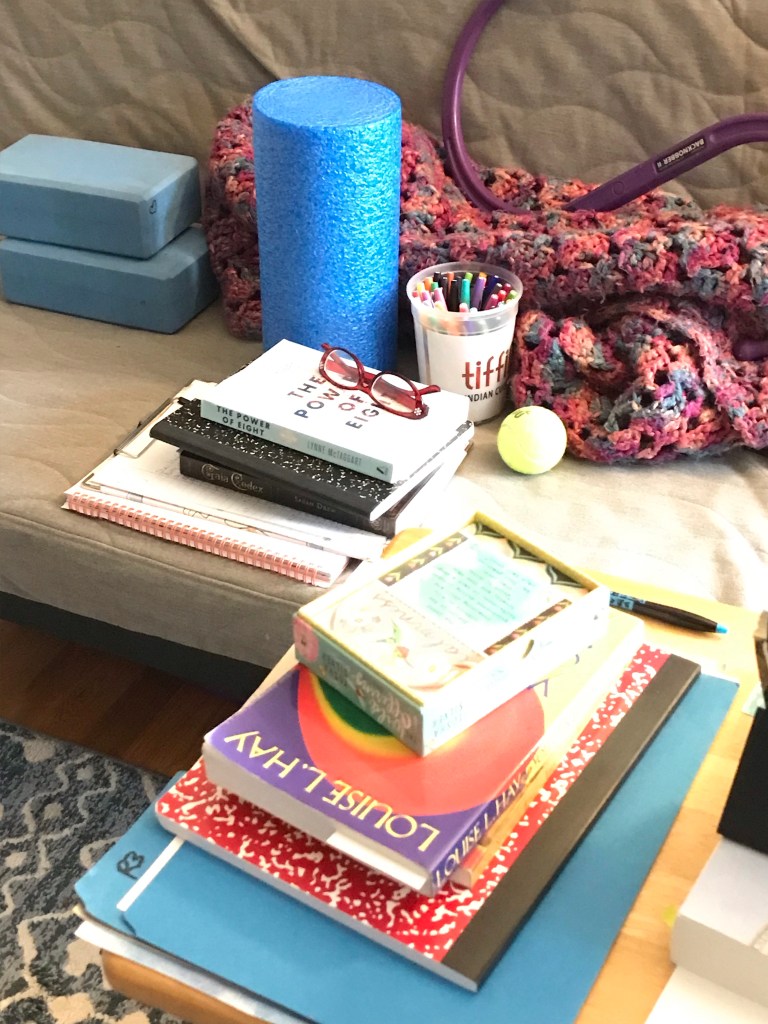
    For the greater part of my days, I’m camped out of my Bio-Mat, surrounded by a stack of books that I’ve wanted to read for ages, a cup of tea, my journal, and an array of colorful markers. There’s something about having a beautiful notebook and great pens that makes the task of inner exploration seem less daunting. As do my comfy pajamas- it’s hard to take things too seriously when you’re covered in lemons and wearing your favorite fuzzy socks. 🙂

    I do have some structure provided by guided meditations and written exercises designed to help me uncover what’s beneath the surface identities that I present to the world. The process of letting go of attachments and conditioned beliefs can be unpleasant, and I have a circle of friends with whom I check in frequently. It’s helpful to hear that they are facing many of the same challenges, and like me, continue to show up and face whatever arises, nonetheless.

    Curiously some physical discomfort has amplified-or is it that I’ve removed enough distractions that I can actually receive the messages my body is sending? I’ve pulled out some massage tools to apply gentle pressure andstimulate circulation. (This is key! The goal is not to punish muscles for misbehaving or to beat them into submission, but to give them some loving attention and bring awareness to postural and movement patterns. More on this in an upcoming post.)

    I ventured out to the farmers market for some produce and have been getting out most days for walks, so I’m not entirely reclusive aside from work. The goal has really been to clear my schedule so I can tune into my needs and desires with minimal influence from those insidious “shoulds”. As it turns out, I prefer books and trees to small talk, media of all forms, and shopping. No surprises there!

    Basically, I’m playing detective and discovering what I can let go of and what I can cultivate in order to move into the new year in the most authentic way. Being present with emotions and sensations seems to be the only way to get an accurate reading on what to keep and what to release. Being still and quiet supports the inquiry.

    We’re really in the darkest of days here in the northern hemisphere as the moon wanes and the winter solstice approaches. It’s really no hardship to stay tucked inside my cozy little apartment as much as possible. While it’s not exactly easy either, I am grateful that I decided to give myself this gift of doing things my way. It’s my hope that you’ll lean into doing things your way too.

    How Slow Can I Go?

    A quick update on my Slowing Down for December intention. The universe heard my request and…

  • Once again, nature is slowing down during these short winter days. Most of the plants are stripped back to the bare minimum and many animals are hunkered down in their dens. I feel the same impulse to stay at home and do less. When I do venture out, I’m moving slowly and intentionally. 

    I’ve cleared my calendar of all extraneous events. Easier said than done, I know! I’m also looking at my daily rituals and habits and wondering which can be paused for now. At first glance, everything seems essential, but I know that’s not entirely true. Which of these tasks are fueled by “shoulds”, such as what society informs me is necessary or from my own ego, clinging to an identity that may no longer be valid?

    Over the next few weeks, I’ll be wiping the slate clean. Letting go of who I think I should be, who I think I am, and who I am expected to be in order to allow the truth to emerge without the imprint of conditioning. The activities I engage in will be flavored with this sense of inquiry and intention of releasing old patterns. For example, this post is still being written (obviously!), and aligns with December’s exploration and my desire to share the processes that support me. 

    (I’m fascinated by how much of life can fall into the “both this and that“ category when I let go of “either this or that“ thinking.)

    While I do still have responsibilities to meet and bills to pay, I’ve created a spaciousness that will allow me to slow down. The goal is to be more present with what arises in each moment in order to be more mindful of my inner landscape. Ideally, this awareness will help me let go of all the embedded beliefs that prevent me from experiencing and expressing my essential self. 

    I imagine a backpack that contains all the beliefs I hold about the world. Some of these concepts were dropped in before I had the capacity to object and others snuck past my defenses when I wasn’t paying attention. It’s my hope to empty this backpack, examine those beliefs, many of which I’ve been carrying around since the 70’s, and carefully choose which to keep and which to discard. Ideally, I will be more discerning moving forward, and only collect items that align with my desires and values. 

    I’m very much looking forward to lightening my load!

    If you have access to Reiki, it can be a helpful tool for analyzing your belief system. I find that activating Reiki when I’m doing any sort of introspection helps me remain in the present moment, focused on the task at hand, without getting too caught up in memories or projection. 

    Reiki also helps me calm my nervous system, reduce the impulses to run away from the discomfort, and accept myself just as I am, 40-year-old baggage and all. My go-to technique is to turn on the flow of healing energy, place one hand on my heart and the other on my belly, and state my intention. I do this at the beginning of my process and whenever I feel the urge to do the laundry, check my emails, or any the other distracting/avoiding/numbing strategies that are so familiar. I return to this hand position and my intention, allowing the Reiki to help me find my center again, as often as necessary. 

    Is there just one thing you can let go of this month that is no longer serving you? I’m choosing to stick firmly to my work schedule and stop making minor adjustments to accommodate clients. There are parts of me that feel afraid that this will affect my income, but I have trust that the clients who are meant to work with me will adapt, and those who aren’t will move on, making space for new ones who are more compatible. 

    I did such a good job of letting something go last year that I can’t even remember what it was! Several years ago, I stopped rushing. That’s one goal that I can recommend wholeheartedly. I allowed more time in between appointments, especially if traveling was involved. I also stopped filling up every last moment with some sort of activity. Now, when I find myself with five minutes until my next client arrives, I take the opportunity to sit quietly and meditate rather than the trying to squeeze in a chore. It’s been great for cultivating a calm feeling within me. 

    I’d love to hear how you’re slowing down. Maybe next month we can truly claim to be moving like molasses in January. 

    Slowing Down for December

    Once again, nature is slowing down during these short winter days. Most of the plants are…